The Eccentric Arundhati, and her Rebellious Mary Roy
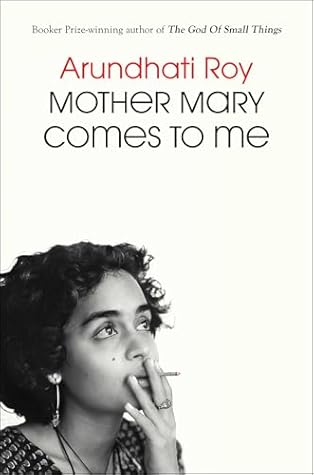 Mother Mary Comes to Me by Arundhati Roy
My rating: 5 of 5 stars
My first introduction to my most favorite author, Arundhati Roy, was brief and unmemorable. One hot afternoon, at my school library class, I picked up a Bengali translation of The God of Small Things, turned a few pages and left the book on its shelf, after the bell for the next period rang. My only impression was, the names sounded weird, and I could not grasp at all what was happening in the story. This was when I did not yet taste the kind of book I would eventually come to love the most. Fast forward to my Engineering school days, I bought a copy of The God of Small Things, the original one, went through the first few pages with some difficulty, and suddenly I got transported to the story. When I finished the book, I found my most favorite author. Whenever I read her later, I didn’t need to spend any effort, I could submerge myself in her language with the fluency of a free bird.
My time with Mother Mary Comes to Me passed so quickly, I could not, for a moment, move my eyes away from the pages when I sat down to read. One evening, I sat on the sofa, kept reading, and got up to wash rice and turn on the rice cooker, without disturbing the flow of reading.
Mother Mary Comes to Me is a memoir of Roy. Memoir of her childhood, her adulthood. Mother Mary comes to the pages, but it was not a book where the author goes on worshipping motherhood and concluding to a mainstream emotion of “mothers are the best”. The book strikes me so fresh with its bold, naked truth, which conventional authors can’t write.
On Mother’s Day, I used to get overwhelmed with the number of Facebook posts of my acquaintances hailing their mothers. I could not relate to them. I wanted to, but I could not. I felt what my mother did for me, what a fierce woman she was (like a man), and I was proud of her, but I could not keep aside the complex chemistry between us. I could not unthink our fights, her wrath on me, her endless tantrums, when I wanted to write about her. Now she has lost most of her wrath against me, but still she comes in my dreams torturing me with her words, and I scream and cry in those dreams, cries of frustration—why my own mother won’t understand me, why I have to carry such longing to get her love and adoration, frustration that my wish about her becoming reasonable one day may not come true. I remember once writing a Facebook post about her anyway, wrote her as a villain, not a hero—it was mostly an immature girl’s cries for sympathy. My Facebook friends responded to the post with positive comments and cheers. One friend wrote “mothers are always mothers”, his personal stance, still it gave me an ache. Roy’s memoir on Mother Mary gave me fresh air on the subject of complexity between mother-daughter relationships. It made me close to Arundhati in a way, I was never to another woman.
Mrs. Mary Roy was a woman, who didn’t want to be tagged as a mother. She wore the hats of a teacher, a warrior, a lone woman fighting against patriarchy. While reading, I could see how that figure shaped Arundhati’s childhood. I also laughed thinking of the phrase “mothers always do the best for their children”. Because however the little Arundhati struggled to find a mom inside Mrs. Roy, in the end she came alright, didn’t she?
What is the book about? About everything… and here are some of my favorite quotes from the book (of course I was highlighting every other page) -
I left my mother not because I didn’t love her, but to be able to continue to love her.
I had to resist the urge to storm back in and sweep all the cute mementos off her coffee table and say, “Excuse me, ma’am, do you have any idea who you just met? If you think she’s just fighting for equal inheritance, you’re wrong. She’s actually fighting for the right not to be a perfect mother, for the right not to be a nice, obedient woman, and most of all for the right not to be a fucking bore like you.”
When I first saw it, the fact that she had finally made herself a home that was so complete, so her, and that it had no place for me, hit me with something like a physical force. My mother’s home didn’t include me at all. But it included Ammal, Mariamma, and Kurussammal—they were all still there. It also included her students, who would come up in batches for treats, or to chat to her. She was complete without me, and I was incomplete without her. I was wrecked. Perhaps I had no right to be.
I didn’t need my mother’s advice because my life with her (Get out of my house! Get out of my car!) had already taught me to live like a bird on a wire. And to prepare to prepare to be prepared.
Also, I still hadn’t lost that very real, very tangible feeling I had carried around since I was a child—the feeling that each time I was applauded, someone else, someone quiet, was being beaten in another room.
The price I paid for being Mother Mary’s daughter and the writer that I am was not prison or persecution (although there was some of that, too). It was catastrophic heartbreak. I did not discuss any of this with Mrs. Roy. She was not the kind of mother with whom it was safe to share your vulnerabilities. I knew I needed to keep a safe distance.
Though we lost, I would not, for anything, have wanted to be on the side of those who won—those who look at a river and want to stop it, tame it, own it, pour concrete and garbage and sewage into it. Kill it.
Big Dams were ecologically disastrous, economically unsound, and politically undemocratic.
When I was reading the pages, I could hear the words falling from Arundhati’s mouth, the activist, the writer. When I was reading about her Architecture school days, I was imagining her as Radha, the eccentric, charismatic Architecture student in In Which Annie Gives It Those Ones. I realized, Radha was she. Tilo from The Ministry of Utmost Happiness, was also she.
Reading her life, not only I got to know my favorite author—Arundhati as a rebelling child, an inspiring adult who never bows her head, the activist-writer she was, I also got to know how my favorite characters from her books were born in her head. Her life came into her books.
An emptiness descended on me when I finished the book, because what am I going to read now? Everything will seem pale, after reading this memoir, this deeply personal, deeply amusing work of art… until her next book…
My notes and highlights from the book
View all my reviews
Comments
Post a Comment